A learning space that connects students with the new skills demanded by today’s labor market. We share the experiences of the Roberto Rocca Technical Gene program in Argentina and the Roberto Rocca Technical School in Mexico.
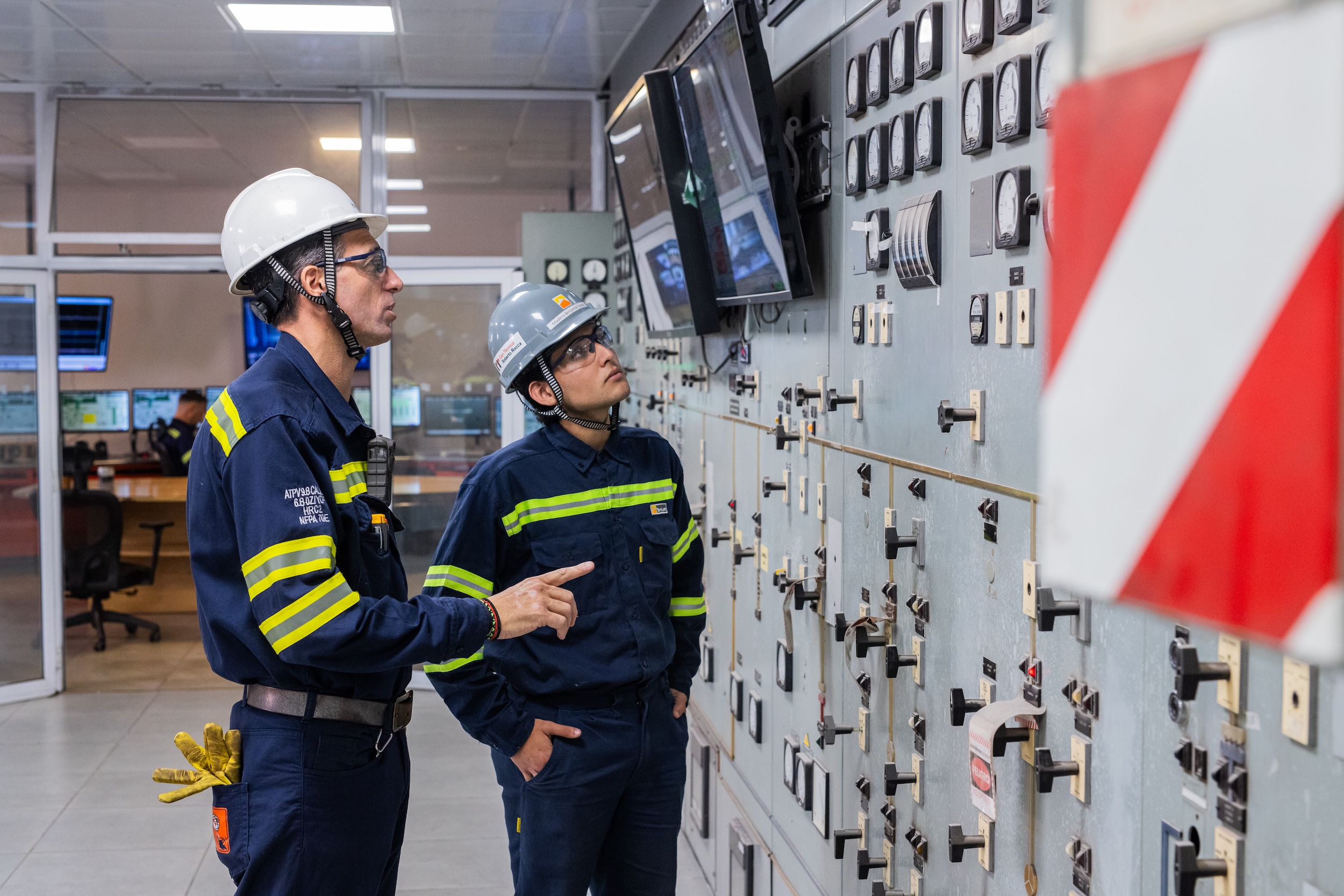
Developing the talent of young people pursuing technical careers through professional internships provides them with a strong foundation for the next step in their educational and professional paths. Both the Roberto Rocca Technical Gene program in Argentina and the Roberto Rocca Technical School in Pesquería, Mexico, have successfully established this opportunity for students in their communities.
Roberto Rocca Technical Gene
At Ternium Argentina, efforts are focused on contributing to community development by promoting education, fostering excellence in STEM fields (Science, Technology, Engineering, and Mathematics), and improving educational environments in technical schools.[1]
For more than 10 years, the global Roberto Rocca Technical Gene program has supported students (and their schools) in technical careers, helping them achieve a smoother transition to the next level of education, industry, or entrepreneurship. One of its main objectives is to strengthen the link between schools and the local productive sector.[2]
The program is made up of different learning paths. One of them is Technical Gene Application, which includes professional internships implemented in coordination between schools and companies.
In Argentina, according to Technical Professional Education Law No. 26,058, professional internships are part of the curriculum and must include a minimum of 200 hours[3]. During this period, students carry out a project or a set of tasks related to a specific area within the company.
Since 2010, 989 students from technical secondary schools in the cities of San Nicolás and Ramallo have completed internships at Ternium Argentina. Of these, 80% specialized in Electromechanics, 10% in Electronics, 7% in Chemistry, and 3% in IT.
By 2022, it was expected that 150 students would complete internships at Ternium Argentina, representing 50% of the enrollment of 7th-year Electromechanics students in technical schools in San Nicolás and Ramallo.
Over the years, we have observed that learning is a two-way process, as it has also generated additional motivation among plant tutors that goes beyond strictly professional aspects. In fact, several of them have voluntarily requested training in so-called “soft skills.” In response, two educational sessions were held focusing on pedagogical aspects of internships and a new approach to supporting students.[4]
The implementation of internships begins four months prior to their formal start, with the company’s selection process. This stage is also considered a valuable learning experience, as students must undergo a psychophysical assessment evaluating verbal, numerical, and mechanical reasoning, as well as attention and concentration levels. In addition, applicants participate in group assessment activities.
In 2019, 68% of students from technical schools in San Nicolás and Ramallo who took the psychotechnical assessment met the expected profile, compared to 60% of applicants in the general market.
Once accepted as interns, students joining different areas participate in an induction process to gain initial exposure to production processes and plant products. Topics such as safety and industrial hygiene are also addressed.
The main areas involved are Engineering and Maintenance, with tasks that include equipment inspection, analytical problem-solving, and hands-on work on the shop floor.
At the end of the internships, tutors evaluate whether students comply with safety and hygiene standards; apply required quality specifications; demonstrate mastery of specialized technical knowledge; show the ability to understand and carry out tasks; and meet assigned objectives responsibly.
Additionally, interns take standardized assessments in mathematics, mechanics, electronics, and electricity together with other final-year technical students to evaluate their technical knowledge.
The company provides each school with a report of the results so that institutions can use this information to drive continuous improvement in their curricula. In 2021, students from participating technical schools exceeded the standard deviation of the control group in these assessments.
That same year, Ternium’s Employment area conducted a report on candidates’ performance in company entry assessments. The report recommends prioritizing candidates from the Roberto Rocca Technical Gene program as a recruitment source, as they achieved the best results. In fact, 83% of them were rated as “top performers.”
One of the main purposes of professional internships is to bring technical school students closer to the industrial world. Workplace learning creates a virtuous network of actors where meaningful learning is built. The experience of entering a plant, working on production lines, and operating alongside machines makes a significant difference in access to future job opportunities.[5]
Thus, professional internships become fundamental in technical education, and the challenge ahead is to link them with the new skills required in the world of work.
The learning paths of Roberto Rocca Technical Gene are based on approaches that promote active learning, especially Project-Based Learning (PBL). These approaches integrate new work-related competencies such as self-management, initiative, and teamwork. They also incorporate STEM education and Industry 4.0 technologies, bringing students closer to developing essential skills for technical training, internships, and life.
The program also seeks to foster critical thinking in students to solve problems. This is achieved, for example, through activities such as Technical Gene Makers (a hackathon focused on real plant-related challenges).
With these new perspectives, a partnership was established with the National Technological University (UTN), San Nicolás Regional Faculty, and FESTO to open a Training Center in Electromechanics and PLC. These centers are equipped with advanced technology and follow a hands-on working methodology.
To ensure that students have the foundations to pursue a technical career, Roberto Rocca Technical Gene includes a Mathematics Track[6]. In the case of internships, the goal is for students to solve workplace problems by formulating and applying mathematical concepts.
Roberto Rocca Technical School in Pesquería
In 2016, in Mexico, the Roberto Rocca Technical School was inaugurated to educate secondary-level students in the community of Pesquería, Nuevo León, using innovative pedagogies and technology in classrooms and workshops.
The Pesquería School is part of a network of Technical Schools that began in 2013 with the Campana School in Argentina. This network aims to develop well-rounded individuals and highly skilled technicians, while also serving as a benchmark for best practices in technical education within the community. It currently has 371 students enrolled in technical high school programs in Mechatronics and Electromechanics[7].
One of the main differentiators of the Roberto Rocca Technical School is its Project-Based Learning methodology, which fosters innovation, teamwork, interdisciplinary thinking, the development of Industry 4.0 skills, and encourages students to think in diverse ways, developing critical thinking and communication skills. All of this enables students to solve problems in their immediate environment and community based on their interests and motivations, while also considering the United Nations Sustainable Development Goals.
The Roberto Rocca Technical School promotes learning linked to the development of technical competencies, and under Mexican regulations, each student must complete 480 hours of professional internships in their final year. However, most of the 371 students have completed internships in companies, dedicating up to 920 hours during their third year.
Since 2016, 74% of Electromechanics students and 85% of Mechatronics students have been placed in companies in the region such as Ternium, Denso, Kia, Metalsa, Prolec GE, Rockwell Automation, FESTO, and Hershey’s, among others.
These positions are highly sought after by graduates of technical schools in the region, and obtaining them requires going through demanding selection processes that include interviews with technical staff, leadership evaluations, and cognitive and technical assessments.
Students are typically assigned to areas such as preventive and corrective maintenance, quality, inspection, and welding. During their internships, they are evaluated monthly on their performance, and at the end of the period, their supervisor assesses their performance across conceptual, humanistic, and technical competencies. Evaluation criteria include understanding project objectives, ethical commitment, communication skills, teamwork, service attitude, use of technical tools, technical knowledge, productivity, and organization.
Despite school closures due to the COVID-19 pandemic in March 2020, a remote learning system was implemented to ensure the continuity, quality, monitoring, and support of internships. Students not only continued their studies but also carried out their internships virtually. Given the importance of this experience, efforts were made to ensure that during the August 2020–June 2021 school year, students could complete their internships without requiring physical presence. Ternium introduced virtual and hybrid internships focused on solving operational challenges and developing innovations for different company areas. Today, approximately 50% of students complete their internships under this model.
This new model, called Technological Innovation Internships (TII), fostered teamwork, digital communication, collaboration, autonomy, creativity, and motivation among students, who—supported by teachers and industry mentors—developed designs, simulations, programming, and functional prototypes to address real business needs.
The relevance of this initiative led the Roberto Rocca Technical School to present this model at the VIII International Conference on Educational Innovation of Tecnológico de Monterrey, one of the most important events in educational innovation in the Spanish-speaking world [8].
In December 2020, during one of the most challenging moments of the pandemic, Ternium University and the Talent Acquisition department reported that 7 out of 10 ETRR graduates were suitable to work at Ternium, compared to 4.3 out of 10 from other technical schools in the region. They also highlighted strong performance in numerical and verbal skills, as well as competencies such as commitment, autonomy, and initiative.
In January 2022, Ternium University issued a new diagnostic report on technical knowledge for 2,454 workers in Argentina, Mexico, and Brazil across critical maintenance specialties. Among the 22 Roberto Rocca Technical School graduates evaluated, 90% passed the test and 70% scored above 90%.
Technical internships within the Rocca School are strategically important, as they contribute to students’ comprehensive development, enabling them to learn from real situations, strengthen technical competencies, face real industrial challenges, and develop problem-solving and social skills required for entering the workforce.
These internships also serve as a benchmark for other educational institutions, strengthening the link between key actors in the technical education process: school–industry–society.
Both experiences show that working with the community drives innovation and continuous improvement in educational systems and programs, leading to more resilient communities and greater opportunities for all. Students learn to manage complexity, technical specificity, and interdisciplinarity required by Industry 4.0, which translates into better employability and, ultimately, social progress.
#TechnicalGene #ProfessionalInternships #STEMSkills #Education #RobertoRoccaEducation
[1] Ternium Argentina. Sustainability Report 2020.
[2] Gras M. & Córdova C. (June 2020). Technical Gene Logical Model. Internal document, p. 1.
[3] Dalla Valle A. The Technical Gene Program at Ternium and the Role of Professional Internships in Training. Technical Gene presentation. Internal document, p. 4.
[4] Dalla Valle A. The Technical Gene Program at Ternium and the Role of Professional Internships in Training. Technical Gene presentation. Internal document, p. 8.
[5] Dalla Valle A. The Technical Gene Program at Ternium and the Role of Professional Internships in Training. Technical Gene presentation. Internal document, p. 9.
[6] Mathematics Strengthening Program 2021: Program Foundations. (July 2021). Internal document.
[7] Ternium México. Sustainability Report 2020.
[8] Tecnológico de Monterrey. CIIE: International Conference on Educational Innovation.
Fernando Favaro: An engineering professional with extensive experience in the development and implementation of Community Relations programs within the Techint Group. He strongly believes that the best investment is in education, and that the challenge ahead lies in rethinking learning through innovative methodologies supported by new technologies.
E-mail: ffavaro@ternium.com.ar
Linkedin: https://www.linkedin.com/in/fernando-favaro-3464b4108/
Daniel Celaya: An education professional within the Roberto Rocca Technical Schools Network (based in Pesquería, Mexico). He has experience in natural sciences, evaluation of social development policies, and youth employability. Passionate about microbiology and photography, but above all about education as a driver of social change.
E-mail: dcelayac@ternium.com.mx